

Teaching
- Seminar: Computer Graphics & Geometry Processing: 2026
Publications within CGG
-
Integer-Sheet-Pump Quantization for Hexahedral Meshing
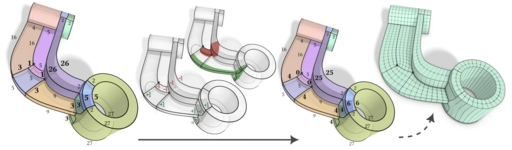
Several state-of-the-art algorithms for semi-structured hexahedral meshing involve a so called quantization step to decide on the integer DoFs of the meshing problem, corresponding to the number of hexahedral elements to embed into certain regions of the domain. Existing reliable methods for quantization are based on solving a sequence of integer quadratic programs (IQP). Solving these in a timely and predictable manner with general-purpose solvers is a challenge, even more so in the open-source field. We present here an alternative robust and efficient quantization scheme that is instead based on solving a series of continuous linear programs (LP), for which solver availability and efficiency are not an issue. In our formulation, such LPs are used to determine where inflation or deflation of virtual hexahedral sheets are favorable. We compare our method to two implementations of the former IQP formulation (using a commercial and an open-source MIP solver, respectively), finding that (a) the solutions found by our method are near-optimal or optimal in most cases, (b) these solutions are found within a much more predictable time frame, and (c) the state of the art run time is outperformed, in the case of using the open-source solver by orders of magnitude.
@article{brueckler2024isp, journal = {Computer Graphics Forum}, title = {{Integer-Sheet-Pump Quantization for Hexahedral Meshing}}, author = {Brückler, Hendrik and Bommes, David and Campen, Marcel}, year = {2024}, publisher = {The Eurographics Association and John Wiley & Sons Ltd.}, issn = {1467-8659}, doi = {10.1111/cgf.15131} } -
Volume Parametrization Quantization for Hexahedral Meshing
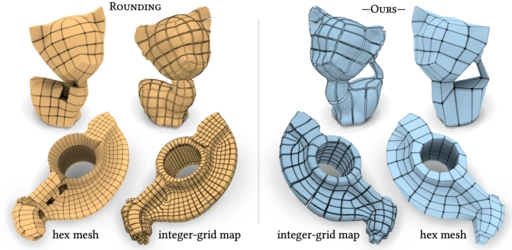
Developments in the field of parametrization-based quad mesh generation on surfaces have been impactful over the past decade. In this context, an important advance has been the replacement of error-prone rounding in the generation of integer-grid maps, by robust quantization methods. In parallel, parametrization-based hex mesh generation for volumes has been advanced. In this volumetric context, however, the state-of-the-art still relies on fragile rounding, not rarely producing defective meshes, especially when targeting a coarse mesh resolution. We present a method to robustly quantize volume parametrizations, i.e., to determine guaranteed valid choices of integers for 3D integer-grid maps. Inspired by the 2D case, we base our construction on a non-conforming cell decomposition of the volume, a 3D analogue of a T-mesh. In particular, we leverage the motorcycle complex, a recent generalization of the motorcycle graph, for this purpose. Integer values are expressed in a differential manner on the edges of this complex, enabling the efficient formulation of the conditions required to strictly prevent forcing the map into degeneration. Applying our method in the context of hexahedral meshing, we demonstrate that hexahedral meshes can be generated with significantly improved flexibility.
@article{brueckler2022qgp3d,
author = {Br\"{u}ckler, Hendrik and Bommes, David and Campen, Marcel},
title = {Volume Parametrization Quantization for Hexahedral Meshing},
year = {2022},
issue_date = {July 2022},
publisher = {Association for Computing Machinery},
address = {New York, NY, USA},
volume = {41},
number = {4},
issn = {0730-0301},
doi = {10.1145/3528223.3530123},
abstract = {Developments in the field of parametrization-based quad mesh generation on surfaces have been impactful over the past decade. In this context, an important advance has been the replacement of error-prone rounding in the generation of integer-grid maps, by robust quantization methods. In parallel, parametrization-based hex mesh generation for volumes has been advanced. In this volumetric context, however, the state-of-the-art still relies on fragile rounding, not rarely producing defective meshes, especially when targeting a coarse mesh resolution. We present a method to robustly quantize volume parametrizations, i.e., to determine guaranteed valid choices of integers for 3D integer-grid maps. Inspired by the 2D case, we base our construction on a non-conforming cell decomposition of the volume, a 3D analogue of a T-mesh. In particular, we leverage the motorcycle complex, a recent generalization of the motorcycle graph, for this purpose. Integer values are expressed in a differential manner on the edges of this complex, enabling the efficient formulation of the conditions required to strictly prevent forcing the map into degeneration. Applying our method in the context of hexahedral meshing, we demonstrate that hexahedral meshes can be generated with significantly improved flexibility.},
journal = {ACM Trans. Graph.},
month = {jul},
articleno = {60},
numpages = {19},
keywords = {hexahedral mesh, base complex, block decomposition, multi-block, t-mesh, block-structured, volume mesh}
}